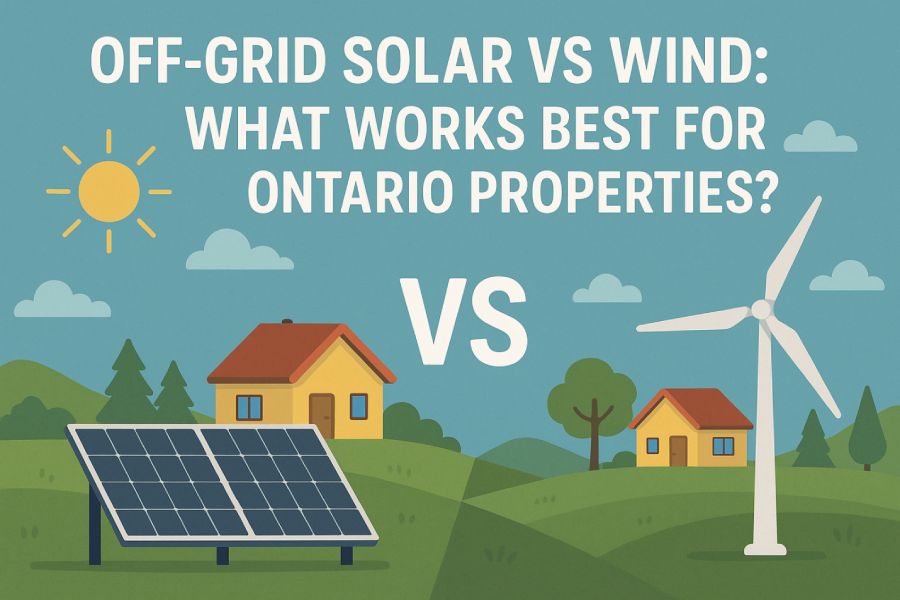
The decision between the two is not an easy one. Climatic factors, topography, power requirements, and serviceability will determine the system that is going to provide optimum performance.
Understanding Power Requirements and Backup Needs
Prior to choosing a renewable system, one should evaluate their overall energy usage, seasonal use, and reserve power demand. In off-grid properties, battery storage is employed to ensure consistent power supply when the generation is low.
Some homeowners combine their systems with solutions such as ups North Bay to make sure that necessary devices will be available in case of weather fluctuations. Both solar and wind are good sources of energy, though their production differs depending on the location and the environment.
Solar Power for Off-Grid Ontario Properties
Solar energy is a popular renewable energy among several off grid Ontario communities. Solar systems are simple to maintain, have predictable production and they work in the sunny seasons.
Late spring and early fall bring a lot of sunshine to the Southern parts of Ontario, which is why solar is a good option to cottages, cabins and country houses. Due to the fact that the solar panels have not many moving parts, there are not many mechanical failures..
Wind Power for Rural and Northern Properties
Wind energy benefits properties in free or open fields with a steady flow of air. An effectively placed wind turbine has the capacity to produce energy at both day and night.
This sustained production may prove to be very handy in the northern or coastal regions that are prone to frequent winds. Wind power systems have to maintain rotor blades, the yaw mechanism and generator bearings periodically, which is unlike the minimal maintenance needed on solar arrays.
Seasonal Considerations in Ontario
Ontario has large variations in seasons, which influence renewable energy generation. Solar functions optimally in early fall, summer, and spring. Late fall and winter in most cases result in wind energy peaks. A variety of property owners resort to hybrid solar wind systems to stabilize these variations.
Wind turbines normally produce more energy in the darkest winter months. Solar panels lead during warmer and sunny days in summer. It is necessary that you know how the seasons affect your property so that you can select the appropriate system.
Installation Requirements and Space Considerations
Solar arrays should be azimuth aligned, have the optimum panel tilt, and spacing, to avoid inter-row shading. It is easy to expand as the panels can be added whenever necessary. Wind turbines need open space and appropriate tower height in order to achieve stable airflow.
Wind systems might not fit well in areas with high density forests or those in low altitudes. Maintenance between the two technologies is also different. Solar systems require simple cleaning and maintenance. Turbine engines need mechanical service periodically.
Conclusion
Whether to use off-grid solar and wind power sources is a decision that depends on the location of your property, the weather and climatic conditions of the season, the amount of electricity you need, and the future ambitions. Solar is easy and easy to maintain whereas wind is robust in winter and 24/7 generation. Combining both is the best choice to provide the most constant supply of energy throughout the year to many Ontario properties.